
Pinterest Organic vs Ads: What Each One Is Actually For
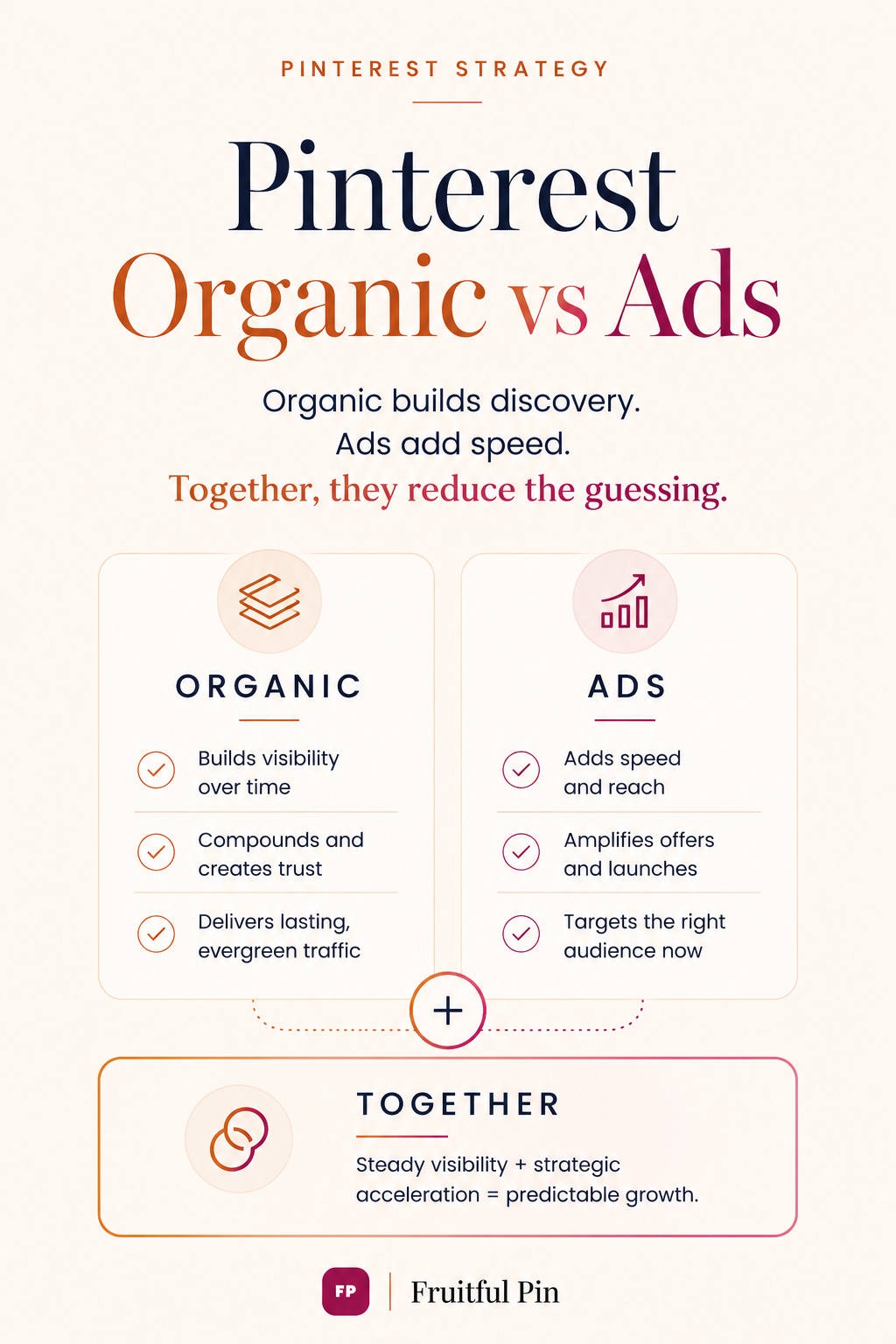
Pinterest organic and Pinterest ads do different jobs. Organic builds compounding discovery over time. Ads buy distribution and speed. The best approach is usually a combo.
By Susy Cid · January 17, 2026

Quick answer
Pinterest organic vs ads: which should you use?
Pinterest organic is best for compounding discovery over time. Pinterest ads are best for faster distribution when your offer, landing page, and tracking are ready. Most brands eventually use both, but the right starting point depends on your timeline, funnel readiness, budget, and capacity.
Key takeaways
The short version before you keep reading.
- Organic = compounding discovery
- Ads = distribution + speed
- Ads amplify what you already have, good or bad
- The combo = fewer guesses, faster results, less waste
- Choose based on timeline, funnel readiness, and capacity
Most businesses treat Pinterest like it has one path: post pins organically and hope it works. That is exactly why so many people quit. Organic Pinterest is real, but it is also a compounding channel. If you expect results in two weeks, you may assume Pinterest is broken when the truth is simpler: you picked a long-game tool and tried to use it like a short-game tool.
Is Pinterest just organic pins?
Reality: Pinterest has ads.
And if you use organic and ads together the right way, you can build compounding discovery and speed up results without wasting budget on a blurry path.
Now let us make this easy.
What is the difference between Pinterest organic and Pinterest ads?
Job #1: Organic Pinterest = compounding discovery
Organic is how you build momentum over time:
- You show up for searches
- Your best content gets saved and resurfaced
- Clicks compound when the system is aligned
Job #2: Pinterest Ads = distribution + speed
Ads do something organic cannot: they buy distribution on purpose.
They can help you get in front of the right audience faster, test messaging and angles quicker, and push a lead magnet or offer now instead of waiting months.
But ads do not magically fix a messy funnel. They amplify whatever you give them, good or bad.
Organic and ads are not competitors on Pinterest. They are teammates.
When should you use Pinterest organic and ads together?
Here is the part most businesses miss: organic and ads are not competitors on Pinterest. They are teammates.
Organic builds the library. You are creating assets that can rank, get saved, and keep driving clicks over time.
Ads put a spotlight on the best shelf. You choose what gets distribution on purpose, especially for list growth or launches.
This is why the combo is powerful: you are not relying on luck or paying for everything forever. You are building assets and strategically amplifying the right ones.
1
The List Growth Combo
- Ads drive targeted traffic to your best lead magnet
- Organic supports it with related pins that keep showing up over time
- Result: you build the list now and build compounding visibility for later
2
The Amplify Winners Combo
- Organic shows you what topics and pages get saves or clicks
- Ads then amplify the winners instead of guessing
- Result: you spend money on what already has signals
3
The Seasonal Push Combo
- Ads give you speed during a short window, like a seasonal sale, peak month, or launch
- Organic builds the long tail so next season is easier
- Result: you stop starting from zero every year
How do you decide between Pinterest organic and ads?
Step 1: What is your timeline?
- Need traction in the next 30 to 60 days? Ads can help if your funnel is ready.
- Okay with 3 to 6 months for compounding? Organic is your base, and you can add ads later.
Step 2: Is your funnel ready enough?
- If your funnel is messy, with an unclear offer, slow page, confusing page, no email capture, or no tracking, start with an organic foundation first.
- If your funnel is proven, with a clear offer, clean landing page, and working tracking, ads become your speed lever.
Step 3: Budget reality
Campaigns can work from 15 dollars a day to 150 dollars a day. The right budget depends on your goal, offer type, and price point.
The mistake is not small budget. The mistake is spending before the path is clear.
Which Pinterest path fits your business stage?
Scenario 1: Blogger or creator with time, but not much budget
You can publish consistently, but ads feel scary or unnecessary.
Start with organic first and build the library.
Why: you can create helpful content that compounds without paying for every click.
Your next step: pick 3 to 5 core topics your audience searches and publish pins that drive to one money page, top post, quiz, lead magnet, or email opt-in so organic traffic has a job.
Scenario 2: Product brand with a budget, but limited time
You have a solid product, you can spend, but you cannot post daily or build content forever.
Start with ads and a light organic base.
Why: ads buy distribution fast, and a small organic foundation keeps you from relying on paid forever.
Your next step: choose one focused landing page, such as a best-sellers collection, category page, or lead magnet, and run a controlled ad test to that page. Then use organic pins to support the same theme so Pinterest learns what you are about.
So, should you choose Pinterest ads or organic?
You do not have to pick a side.
Organic and ads do two different jobs, and the right sequence depends on your timeline, funnel readiness, and capacity.
If you want help choosing the right path and the right order for your business, especially if your goal is list growth, book a Fit Call and we will map it out with clear priorities and budget guardrails.
Frequently asked questions
Quick answers before you choose a path.
Should I start with organic Pinterest or ads?
Start with ads if you need traction in 30 to 60 days and your funnel is ready: clear offer, clean landing page, and working tracking. Start with organic if you have time to build compounding discovery and you are still tightening your pages. Most brands do best with a combo once the foundation is in place.
How long does Pinterest organic take to work?
Usually months, not weeks. Organic Pinterest compounds when your topics, keywords, and landing pages stay consistent. Expect a slower start, then a few winners, then momentum as Pinterest learns what you are relevant for.
What does funnel-ready mean before running ads?
A fast mobile page, clear offer, clear next step, and enough context for a cold visitor to understand what to do. If the click comes from lead magnet intent, the page should deliver that immediately. No scavenger hunt.
Can Pinterest ads work with a small budget?
Yes. Small budgets can work when the path is clear. The mistake is not small budget. It is spending before the message, landing page, and tracking are solid. Start controlled, learn quickly, then scale what proves itself.
What should I promote with Pinterest ads first?
One focused destination: a lead magnet, best-sellers collection, category page, or a high-converting product page. The simpler the path, the easier it is to measure what is working.
Want this mapped to your brand?
Start with a Fit Call and we'll look at your content, offer, and Pinterest opportunity without guessing.
Book a Fit Call