Pinterest in 2026 for Product Brands: Pretty Pins Don’t Win. Strategy Does.

By Susy Cid • January 17, 2026

I can’t believe I’m saying this in 2026 — roughly 16 years after Pinterest launched — but Pinterest is still one of the most underrated platforms for baby + family product brands.

And no, it’s not because brands “haven’t tried hard enough.” It’s because they try Pinterest like it’s Instagram: pretty product photos, auto-posted, then abandoned.

I work with numerous baby and family brands, so I’ll use those examples — but the system applies to most product categories.

Pinterest isn’t a moodboard. It’s a sales systemif you build it like one.

If Pinterest is on your marketing list this year, this post is here to save you from the most common outcome I see: you spend weeks making pins, get a small spike (or nothing), decide Pinterest is “meh,” and move on.

Meanwhile, the real issue was never the pin design. It was the strategy underneath it.

Marketing is louder now. More platforms, more ads, more content, and yes — more AI-generated sameness.

So if your Pinterest approach is basically:

  • post a cute lifestyle photo of your product (baby in a perfect beige nursery, of course)
  • add a caption like “new drop ✨”
  • link to your homepage or a random product page
  • …you’re not running Pinterest. You’re uploading photos.

In 2026, Pinterest rewards baby/family brands that are clear about three things:

1) What you sell (and who it’s for)

Not “baby sleep product.” More like: newborn sleep support, toddler bedtime routine, nursery essentials for small spaces, registry must-haves for first-time parents.

2) What problem do you solve / what outcome do you deliver

Pinterest is in planning mode. Think:

“baby registry essentials,” “nursery setup checklist,” “toddler travel essentials,” “playroom organization,” “new mom gift ideas.”

Your product must align with those intentions.

3) Where you’re sending the click (and whether it converts)

Pinterest can drive traffic. But traffic to a broken funnel is just… expensive disappointment.

If someone clicks “nursery organization” and lands on a slow page, a confusing collection, or a product with zero context — that’s not a Pinterest problem. That’s a landing problem.

That’s the 2026 shift in one line: Pinterest still works — but it doesn’t reward vibes-based marketing.

Key takeaways

  • Pinterest is planning + shortlisting, not “hanging out.”
  • Your pin needs a clear who it’s for + outcome
  • Homepage links usually underperform for Pinterest traffic
  • Fix intent → promise → path before making more pins
  • Landing pages matter as much as the creative
  • Organic compounds over months; ads accelerate when the funnel is ready
  • “Vibes-based marketing” gets ignored in 2026

5-step setup

  1. Pick 3–5 categories you want to be found for
  2. Build boards + keywords around shopper intent
  3. Define the job of each click (shortlist, educate, decide, buy)
  4. Create the right destinations (collection/guide/bundle/product)
  5. Publish multiple angles per category, then track clicks + conversions

1) It’s not small. It’s massive.

Pinterest reported 600 million global monthly active users (Q3 2025).

2) Gen Z is a huge chunk of the platform and they’re there to shop.

Pinterest’s own audience data says Gen Z is 42% of its global user base and the main reason Gen Z uses Pinterest is to find info about products/brands.

3) Pinterest is building harder into shopping + performance.

They’ve rolled out ad tools like Top of Search ads (prime placement when people are actively searching).

And they’ve introduced where-to-buy links that make image ads more directly shoppable (especially relevant if you sell through retailers).

So the real question isn’t “does Pinterest still work?”
It’s: are you using it like a sales system… or like a photo album?

Here’s the simplest way to think about Pinterest:

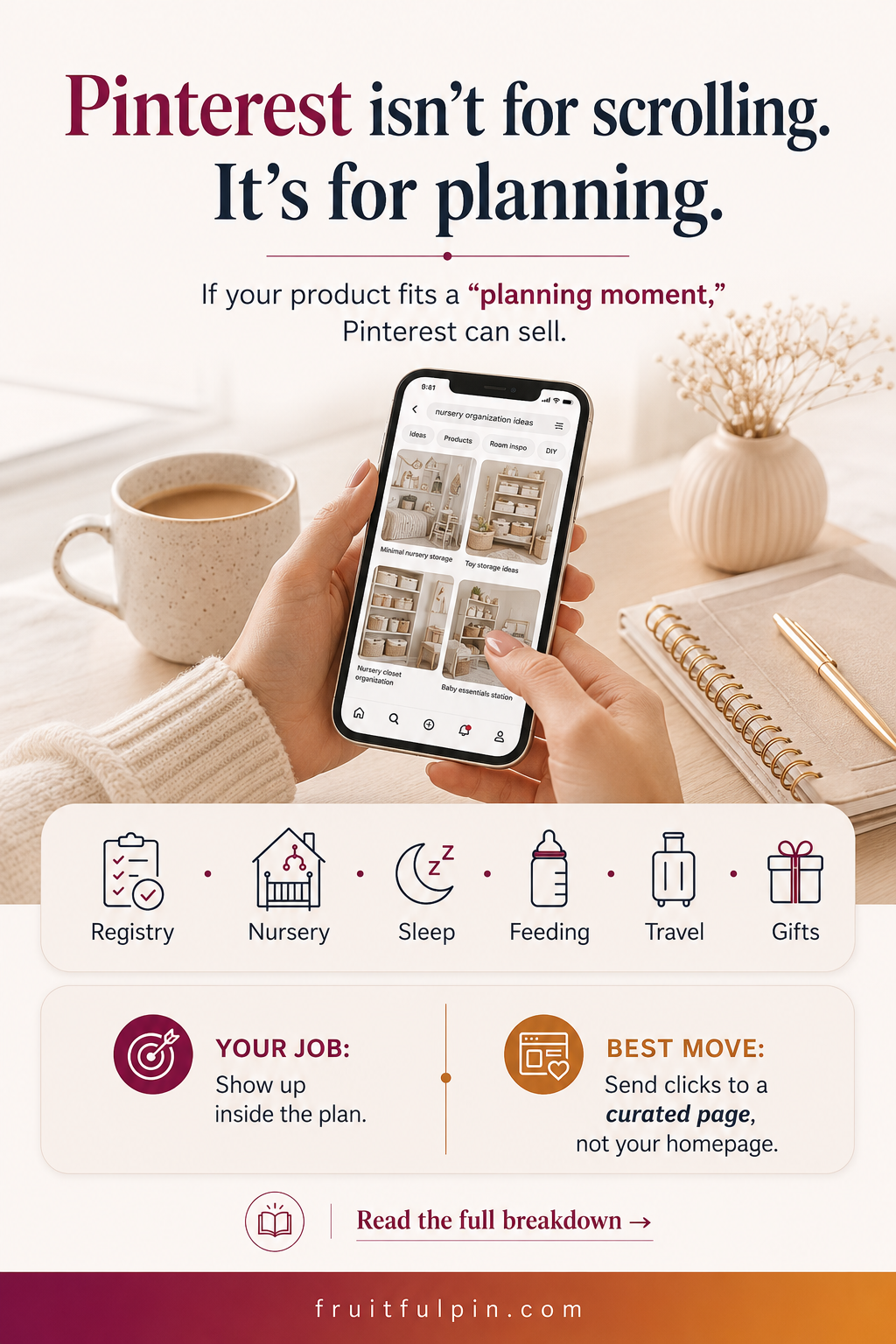
Pinterest isn’t where people hang out.

It’s where they plan.

That planning energy is basically baby/family life in one sentence:

  • building a registry
  • setting up a nursery (small space, shared room, etc.)
  • troubleshooting sleep
  • starting solids
  • traveling with a baby or toddler
  • buying gifts for baby showers and new parents

Pinterest works best when your content helps someone move from:

idea → shortlist → click → decision

That’s why the “pretty pin” approach falls flat. Pretty is fine. But Pinterest rewards clarity:

  • What problem is this solving?
  • Who is it for?
  • What situation does it fit into?

Pinterest can be a monster channel for baby/family products — but it’s not magic for everyone.

If you’d rather see the math than guess: run the Pinterest Potential Calculator to estimate your potential audience size — and the money you’re probably leaving on the table by ignoring Pinterest.

Now answer these fast:

  • Do people actively search for your category? (sleep, feeding, registry, nursery, travel, toys, organization)
  • Do you have a few clear product categories you can “own” with repeatable content angles?
  • Do you have pages worth clicking to? (fast, mobile-friendly, clear offer, clear next step)
  • Can you commit to a real timeline? (think 6+ months for organic compounding)
  • If you need speed: do you have a proven funnel so ads can scale?

If you’re nodding yes to most of these, Pinterest isn’t “one more platform.” It’s a channel you can build into your ecosystem and let it compound.

If you’re nodding no, that’s not a dealbreaker — it just means we fix the system before we add more work. Because more pins won’t fix a broken map.

If you’re looking at Pinterest and thinking, “Could this replace Instagram?” or “Do we even need Google if we do Pinterest?” — here’s the truth:

No single platform replaces having a holistic marketing system.

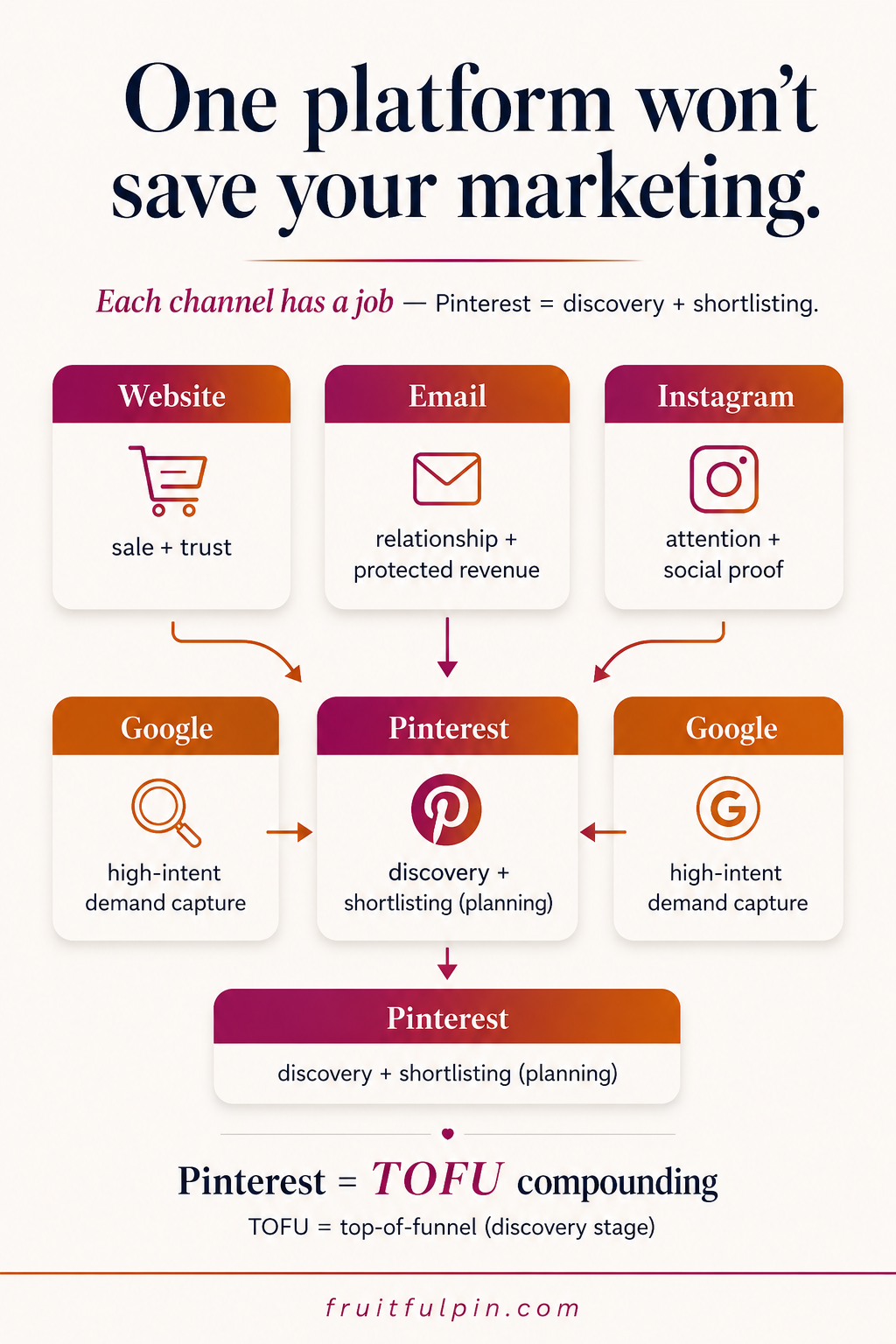
What actually works for product brands looks like this:

  • Your website = where the sale happens (and where trust is built)
  • Your email list = where the relationship compounds (and revenue is protected)
  • Instagram = attention + trust (social proof, UGC, founder POV)
  • Google = high-intent demand capture
  • Pinterest = discovery + shortlisting (planning before purchase)

Each platform has a job. If you force one platform to do every job, you end up with traffic that doesn’t convert and a team that’s exhausted posting “more” with nothing to show for it.

So where does Pinterest fit in that system?

For baby/family brands, Pinterest is usually your top-of-funnel discovery engine that feeds your site + list.

But here’s the part most brands miss: with Pinterest ads, it can play bottom-of-funnel too.

If you have a proven offer + clean landing page, you can use ads to:

  • retarget warm visitors
  • show up on high-intent searches (including premium placements like Top of Search)
  • drive conversions faster than organic alone

So the real positioning is:

  • Organic Pinterest = TOFU compounding
  • Pinterest Ads = TOFU + BOFU acceleration (when the funnel is ready)

Ads don’t fix a broken funnel — they just reveal it faster.

When Pinterest feels “meh,” it’s usually not because your pins aren’t pretty enough.

It’s because the click lands… and nothing useful happens.

So here’s the rule to steal:

On Pinterest, every click needs a job.

Not “send traffic.” A job.

Because someone searching “baby registry essentials” is not in the same headspace as someone searching “how to get baby to sleep.” If both clicks go to your homepage, you’re basically telling Pinterest: I don’t know what this click is for either.

#1: The pin promise doesn’t match the page

  • Pin says: “Nursery essentials for small spaces.”
  • Page is: a generic shop page with 40 products and no guidance
  • That’s not a Pinterest problem. That’s a “you broke the promise” problem.

#2: Your keywords don’t match shopper language

  • Brands name things like a product catalog. Pinterest users search like real humans with a problem.
  • If your pins and boards don’t mirror real searches, Pinterest can’t place you.

#3: The click has no next step

Pinterest traffic is often first-time traffic. They need a clear path:

  • A collection that fits their situation
  • A bundle that simplifies the decision,
  • An email capture that makes sense
  • If none of that exists, you’re paying (with time or ad dollars) to generate bounce rates.

What “a click has a job” looks like for baby/family brands

  • Search: “baby registry essentials.”
  • Click’s job: shortlist + trust
  • Best destination: curated collection + “why these” bullets + quick email capture (“registry checklist”)
  • Search: “nursery organization ideas.”
  • Click’s job: education → product fit
  • Best destination: guide + product modules or a collection built around small-space setups
  • Search: “best gift for new mom.m”
  • Click’s job: decision simplification
  • Best destination: giftable bundle page (clear price, who it’s for, shipping, reviews)
  • Search: “toddler travel essentials.”
  • Click’s job: planning list → add-to-cart
  • Best destination: travel collection + bundle + “what to pack” checklist

That’s the difference between “Pinterest as a moodboard” and “Pinterest as a sales system.”

It’s intent → promise → path.

Stop doing this (the fastest ways to waste time on Pinterest)

Stop #1: Auto-posting Instagram content and calling it a Pinterest strategy

Pinterest isn’t a feed. It’s search behavior with images.

Stop #2: Posting pretty product photos with no intent

Attach your product to real searches (registry, nursery, gifts, routines, travel).

Stop #3: Sending every click to the homepage

Homepages are for browsing. Pinterest clicks usually want a specific answer.

Stop #4: Trying to brute-force results with more pins

More pins won’t fix a broken map.

Stop #5: Expecting organic sales in 2 weeks

If you need speed and you already have a proven funnel, use ads. If you don’t want ads, commit to the long game.

  • Organic Pinterest: plan for at least 6 months to build compounding momentum
  • (consistency + SEO structure + click-worthy pages)
  • Pinterest Ads: can move faster if your funnel is already proven
  • (and if it isn’t… you’ll find out quickly)

Pinterest results aren’t linear. You’ll often see:

slow start → a few winners → compounding once your map and angles are dialed in.

Pinterest is a slow oven, not a microwave.

  • ✅ Pick your categories (what you want to be found for)
  • ✅ Build your board + keyword map around real shopper intent
  • ✅ Define the job of each click (intent → promise → path)
  • ✅ Fix your money pages (fast, clear, mobile, next step)
  • ✅ Create multiple angles per category (not one pin per product forever)
  • ✅ Commit to consistency (or use ads if you need speed)
  • ✅ Measure what matters (clicks, top pages, saves as signal — not follower count)

If you want help mapping your Pinterest sales system (what to pin, what to target, and where each click should land), book a free consult — and we’ll turn “Pinterest is on our list” into an actual plan.

FAQ’s

Yes—especially for brands that sell into planning-driven categories (home, beauty, baby, organization, gifts, travel). Pinterest is intent-heavy because people search and save while planning purchases. It works best when your pins map to real searches and your landing pages finish the job.

Most brands need months, not weeks. Organic Pinterest compounds when your SEO structure (boards + pins) and landing paths are consistent. Expect a slower start, then momentum as Pinterest learns your relevance and your “winners” stack.

Usually not the homepage. Pinterest traffic often comes from a specific intent (“gift ideas,” “small space nursery,” “travel essentials”). Send that click to a page designed for that intent—like a curated collection, guide, bundle page, or product page with context.

They can be—if your funnel is already proven. Pinterest continues to build shopping and performance ad placements (like Top of Search). Ads don’t fix a broken funnel; they just show you the cracks faster.

Misalignment. The pin promises one thing, but the page doesn’t deliver—or the page is slow/confusing with no clear next step. Fix intent → promise → path before you publish more pins.

If people search for your category/problem (not just your brand name), you have a few product categories you can consistently create angles for, and your site is mobile-friendly with clear paths to purchase or capture—Pinterest is likely a fit.

Clicks and what happens after the click (landing page performance + conversions). Saves can be a useful signal of future intent, but follower count is usually a vanity metric for ecommerce performance.

I’m Susy, a Pinterest strategist helping content creators and specialty brands build long-term traffic and sales — without burning out.

Learn more

Want more Pinterest strategies in your inbox?

Get sustainable Pinterest tips, case studies, and tools — no spam.

Looking for tools & freebies?

Explore checklists, mini-courses, and recommended tools.

Visit the Resources Hub